The path toward clean oceans starts at the shore.
Right now, ports are stuck. While nearly all have some form of sustainability plan and make some headway, the federal grants and incentives vital for supporting efforts like electrification have diminished under the new U.S. administration.
COAST aims to prove that ports never have to choose between profitability and sustainability.
Role
Visual/UI Design Lead
Year & Duration
2025 | 20 Weeks
Team
nick pratt, pingyao wan, krishna aggarwal, austin joseph, emiliano resendez
Ports are responsible for a significant share of maritime emissions—yet most sustainability solutions demand budgets and downtime they simply don’t have.
COAST changes that. Rather than costly infrastructure overhauls, we treat port energy management as a fluid process built on accessible information and continual improvement.
01
my role & responsibilities
I led the visual and tone direction for COAST, designing the logo, establishing the aesthetic system, and shaping the brand's overall feel. That foundation carried into the UI, where Nick Pratt and I built out a cohesive design system and component library, taking the product from wireframes to high-fidelity screens. Throughout, the goal was making sure every interaction felt intentional, intuitive, and distinctly COAST.

Brand Identity Development
Visual System & Design Language
High-Fidelity Screen Design
End-to-End UI Strategy
User Flow Optimization
Product Interface Architecture
Prototyping & Validation
02
THE PROBLEM SPACE
Ports want to go green. What’s missing isn’t urgency.
It’s visibility.
Ports rarely make it into the clean energy conversation, even though they sit right at the center of maritime shipping’s 3% share of global emissions. Diesel equipment runs nonstop. Shore power often goes underused. And because port operations are so large, small inefficiencies quietly scale into massive impact.
Port leaders want to decarbonize, but most solutions assume extra budget, extra staff, or operational downtime they simply don’t have. With shrinking incentives and rising pressure, sustainability can feel abstract and unattainable.
In our research, one theme kept surfacing: the problem isn’t motivation, it’s visibility. Ports can’t fix what they can’t clearly see.
80%
OF WORLD TRADE CARRIED BY SEA
$2.89
TRILLION
IN AMERICAN ECONOMIC ACTIVITY FROM PORTS
9
IN-DEPTH USER INTERVIEWS CONDUCTED
362
UNIQUE PRIMARY RESEARCH DATA POINTS
03
research & insights
Complex systems, constrained by capital, coordination, and operational risk.
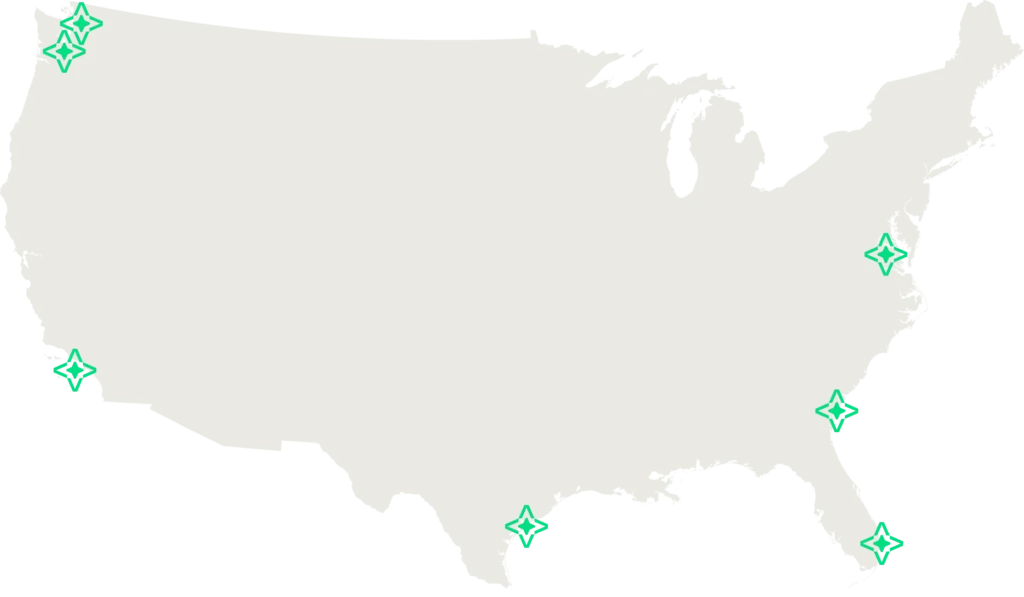
We engaged federal maritime leadership, port authority decision-makers, and marine science experts to ground the work in real institutional and environmental realities.
tim Gallaudet
Former Deputy Administrator
National Oceanic and Atmospheric Administration (NOAA)
Former Oceanographer of the Navy
U.S. NAVY
CEO
Ocean STL Consulting
Chief of Planning and Development
Port of Everett
Director of Environment & Sustainability
Port of Hueneme
Manager, Strategic Projects and Partnerships
Georgia Ports Authority
Coordinator
Gulf of Mexico Coastal Ocean Acidification Network (GCAN)
Senior Environmental Program Manager
Port of Seattle
Marine Biologists
MULTIPLE ACROSS DIFFERENT REGIONS & AREAS OF EXPERTISE
FINDINGS & FORECASTS
our Key Findings
04
1
Electrification Is Necessary, But Financially Complex.
Shore power and fleet electrification can cut emissions quickly, but large-scale retrofits demand serious capital, often reaching tens of millions. Even promising alternatives carry steep barriers: hydrogen currently costs 4 to 5 times more than diesel. The throughline across every conversation was the same: sustainability initiatives stall without a clear economic case. Adoption is driven by risk-adjusted return, not intent alone.
“You can’t just drop in new infrastructure and expect it to work. It has to integrate with what’s already there.”
Chief of Planning and Development, Port of Everett
2
Progress Is a Coordination Problem.
Ports are ecosystems of public agencies, utilities, terminal operators, shipping lines, and surrounding communities. No single solution exists, and no single stakeholder can move alone. Aligning port authorities, utilities, policymakers, and communities is what determines speed. Technology can enable the transition, but alignment is what drives it.
“If you’ve seen a port, you’ve seen one port — they’re all very, very different.”
Director of Environment & Sustainability, Port of Hueneme
3
Operational Intelligence Is Undervalued.
While infrastructure transitions unfold over years, daily operations continue with limited visibility into real-time energy performance. Ports are being asked to decarbonize without full insight into their own energy systems. Integrating AI for energy management, emissions tracking, and predictive modeling addresses this gap directly, and represents one of the most immediate opportunities for impact.
“Speak about it as a challenge and an opportunity. Look for the economic gains that can be made by adapting.”
Tim Gallaudet
05
RESEARCH OUTCOMES
Currents & Constraints
Our research reframed the challenge: ports aren’t choosing to be slow adopters and beacons of change. They face capital thresholds, infrastructure constraints, and multi-stakeholder complexity that leaves environmental efforts in the wake.
Making Energy Measurable
Ports need real-time operational insight to act.
Translating Emissions into Operational Intelligence
Data must map to decisions.
Aligning Environmental Progress with Financial Incentive
Economic case drives adoption.
Operational intelligence dashboards to surface measurable savings.
Prioritizes investments and unlocks funding by showing ROI.
Development of platform and easily integratable across ports everywhere.
Making Energy Measurable
Ports need real-time operational insight to act.
Translating Emissions into Operational Intelligence
Data must map to decisions.
Aligning Environmental Progress with Financial Incentive
Economic case drives adoption.
06
Testing & Validation
We put COAST in front of ten users. They sailed us even further.
We ran moderated task-based usability sessions across seven core flows — from toggling individual cranes to accepting AI recommendations and recovering from a non-responsive sensor. The results held up; the friction points were specific.
10
Testing Participants
7
Tasks per Session
91%
Average Success Rate
3
Design Iterations Triggered
Task-by-task results
Turn on the tide generators
Turn off Crane 1A in Berth 1
Message Operations to refuel forklift FL-01
Turn off Reefer RC-0981
Accept the "Shore Power Near Capacity" recommendation
Accept the "Switch Diesel Forklifts to Electric" recommendation
A sensor isn't responding — manually reset the Axon
07
Final Outcome
A two-part system that turns existing port infrastructure into actionable intelligence.
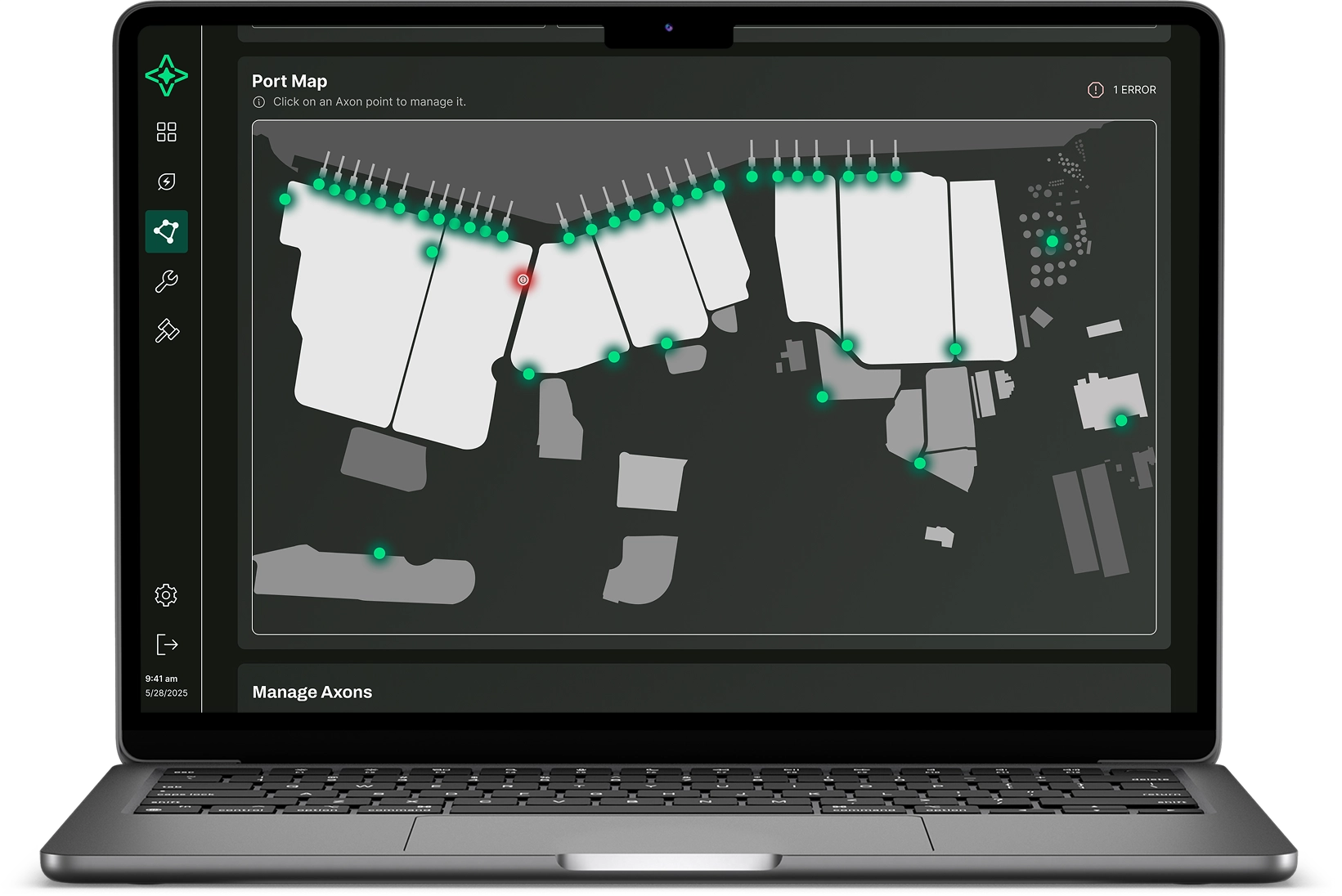
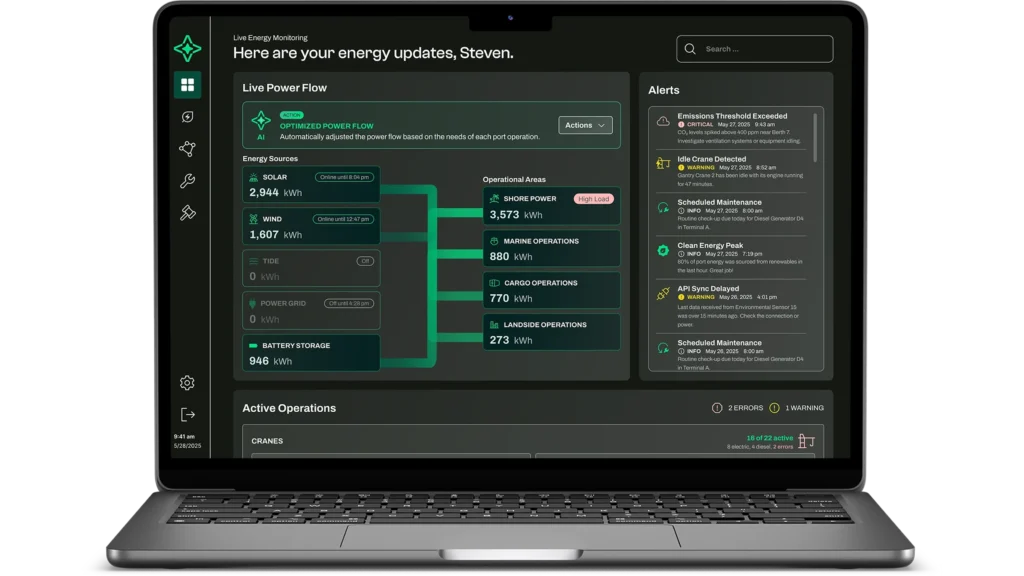
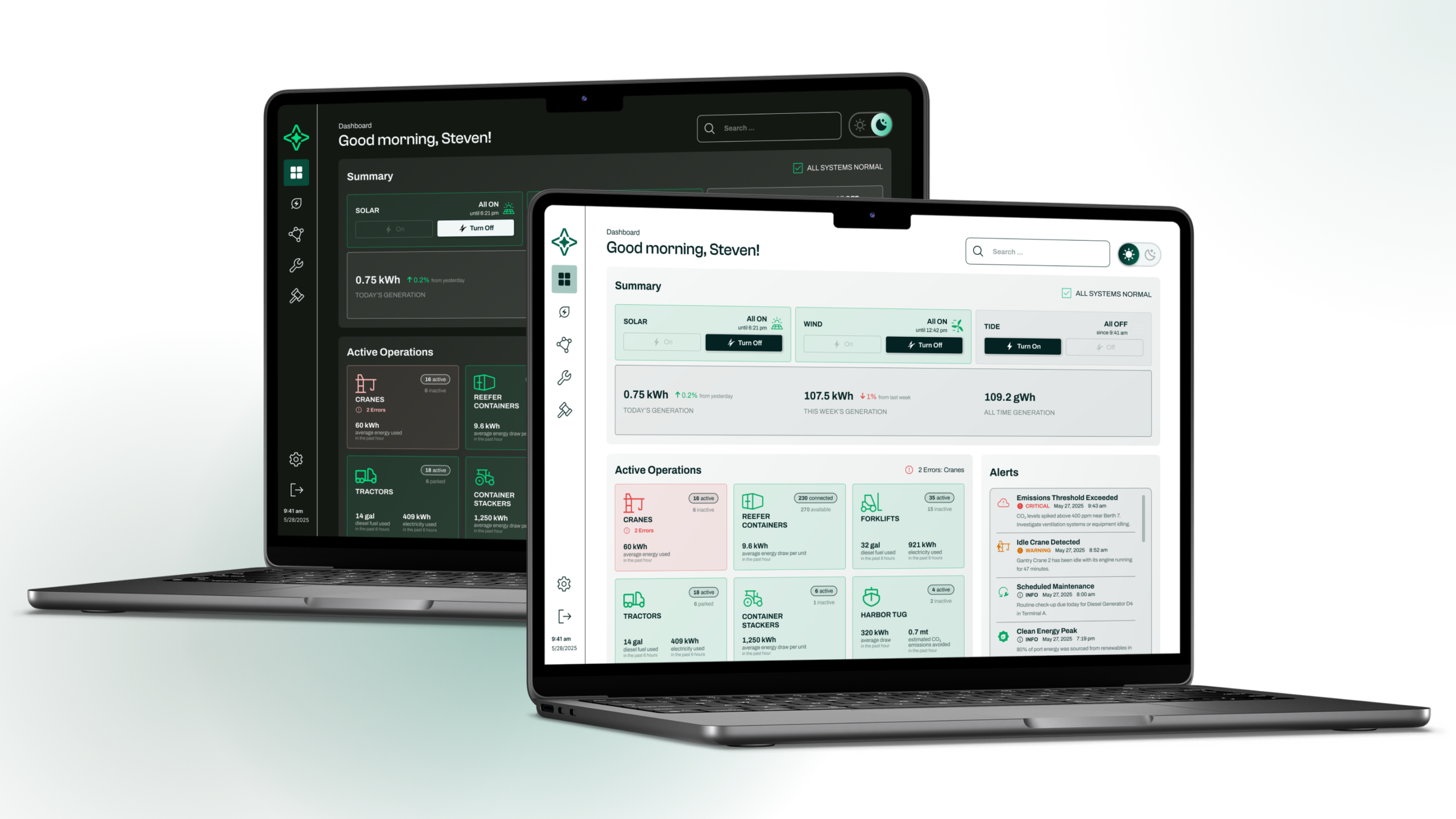
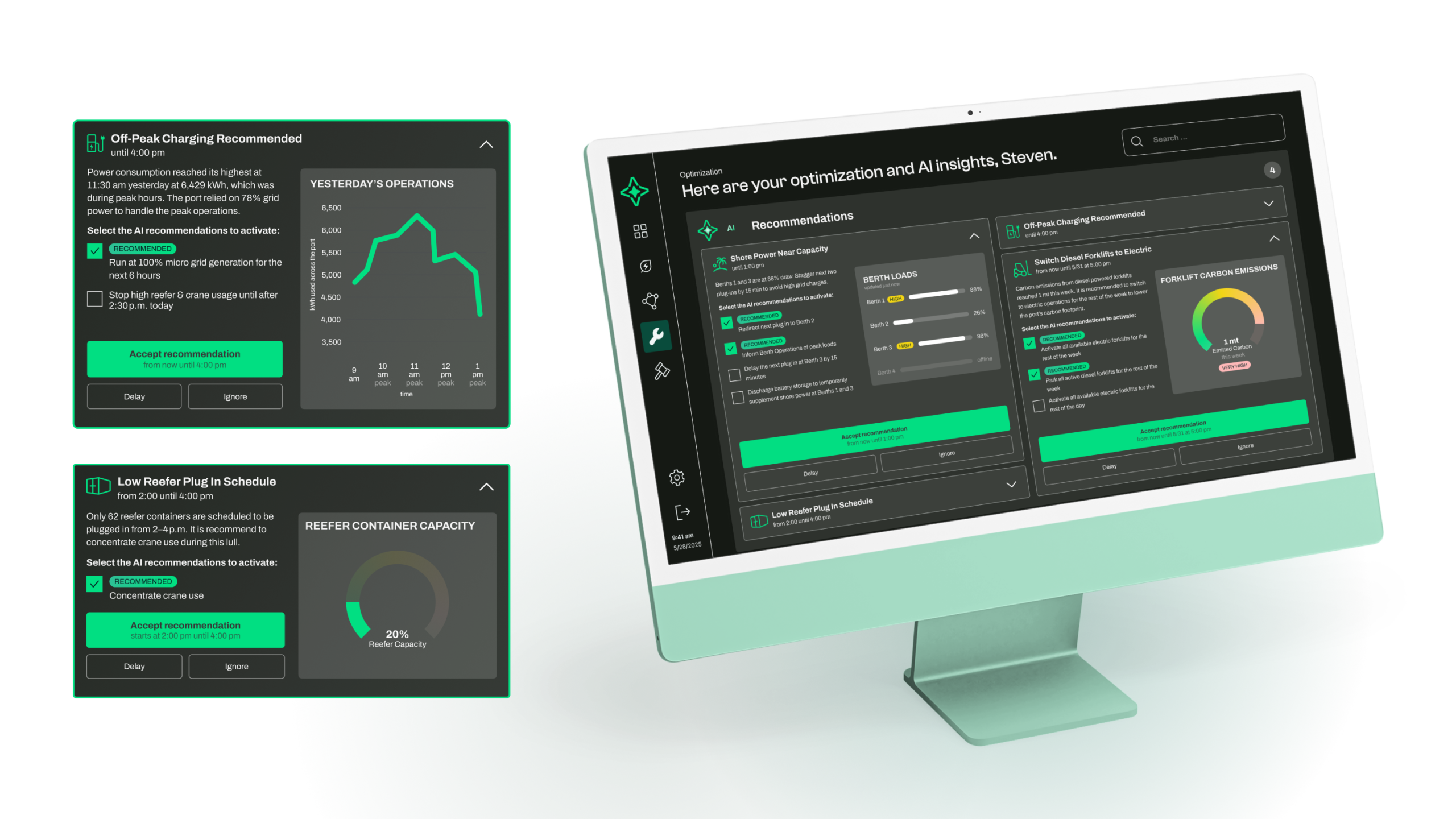
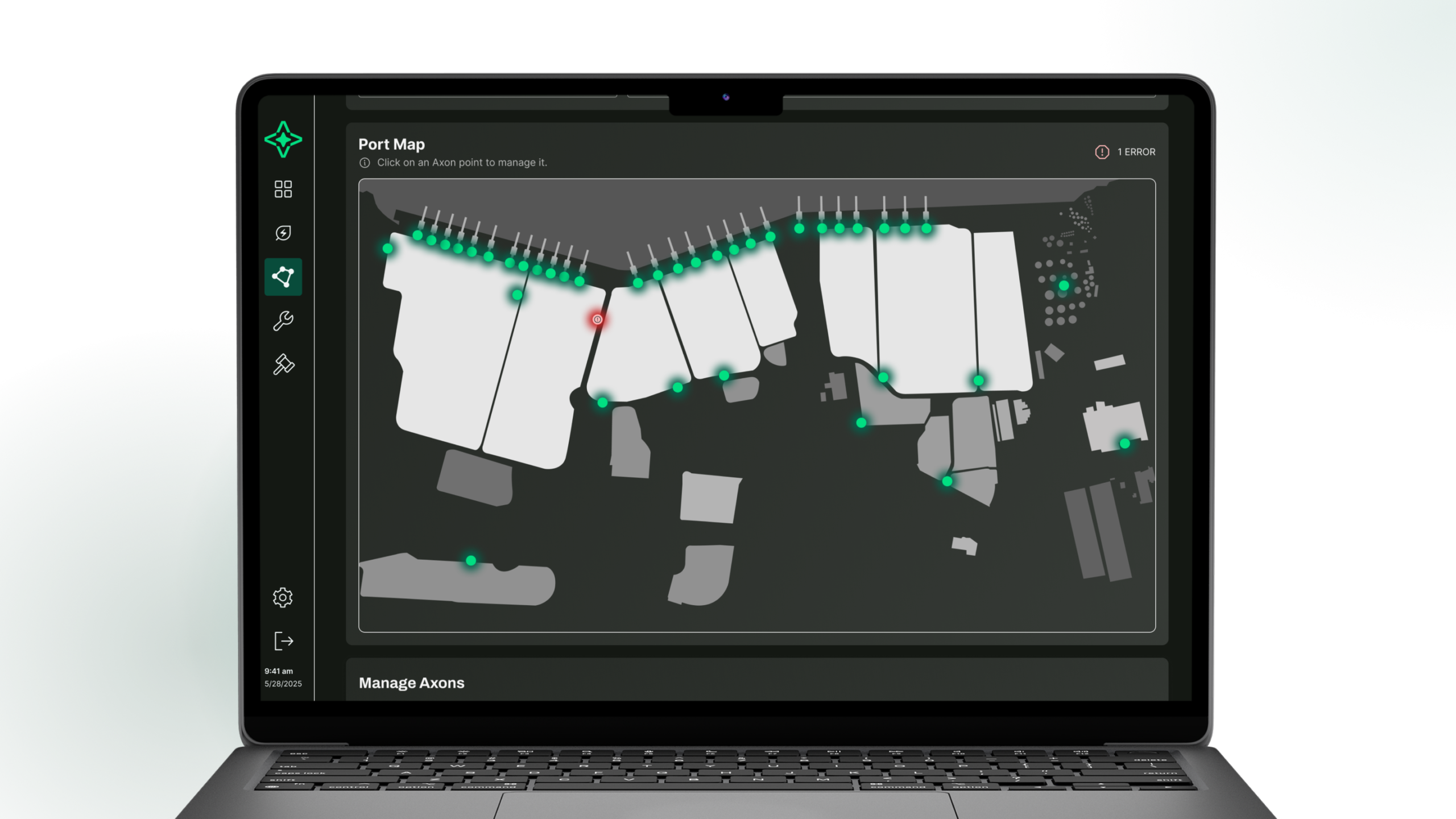
An AI-powered command center that reads everything Axon collects. It tells operators what’s working, what isn’t, and exactly when to shift loads, service equipment, or throttle usage — without hunting through spreadsheets.
Predictive AI recommendations
Real-time microgrid control
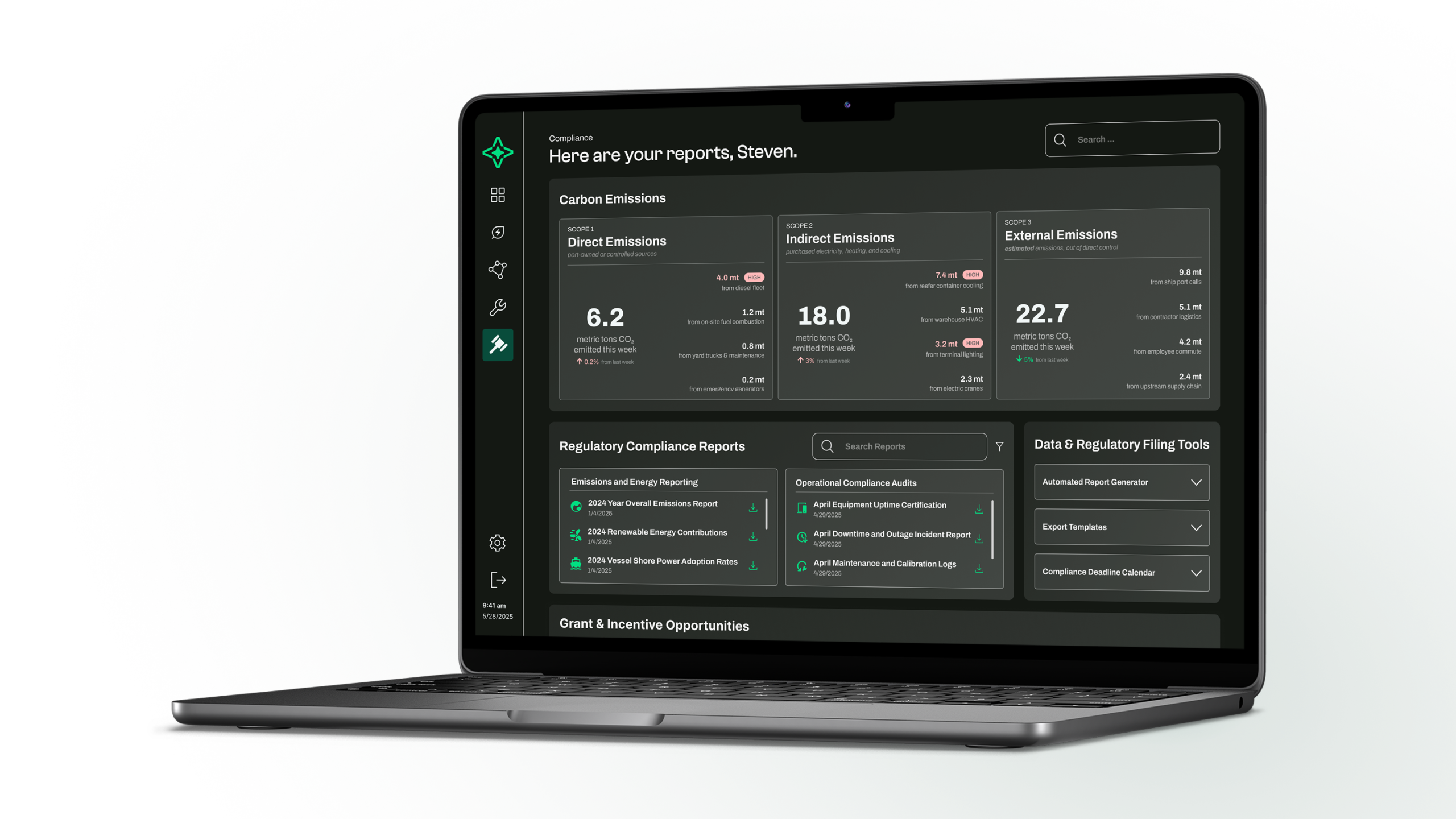
Grant & ROI reporting
Consolidated alerts
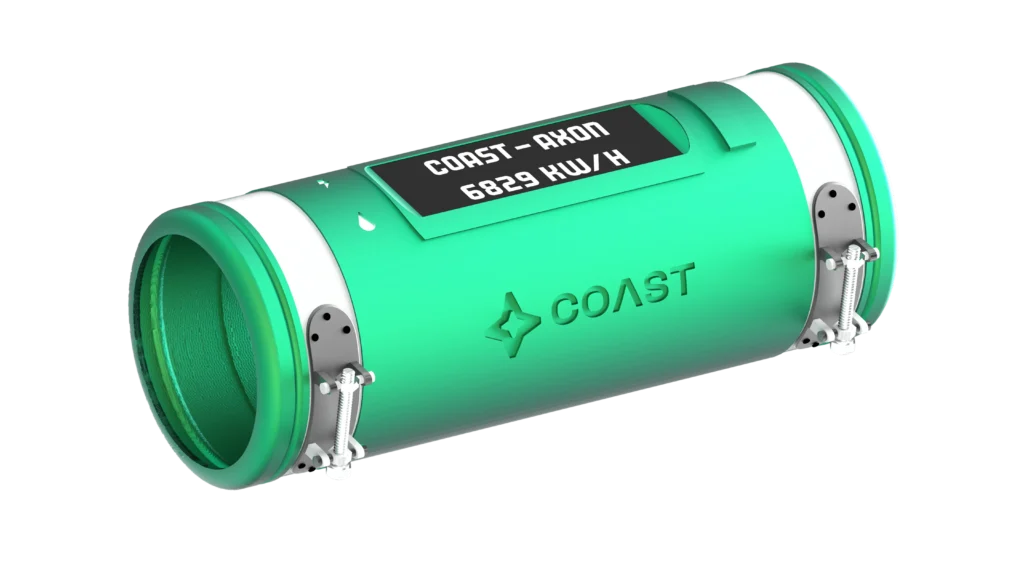
Axon
The sensor that listens.
A weatherproof clamp-on sensor that snaps onto existing power cords and fuel lines. No new wiring. No new generators. Just live data on how much electricity and fuel every piece of equipment actually uses.
Real-time monitoring
Cloud-synced
Weatherproof exterior
Retrofit, not replace


06
recognition
Awards & Accolades
COAST has been recognized internationally for its approach to making port decarbonization legible, measurable, and actionable — and validated by the maritime leaders shaping the field.
NEXT PROJECT
DESIGNER
Mackey